
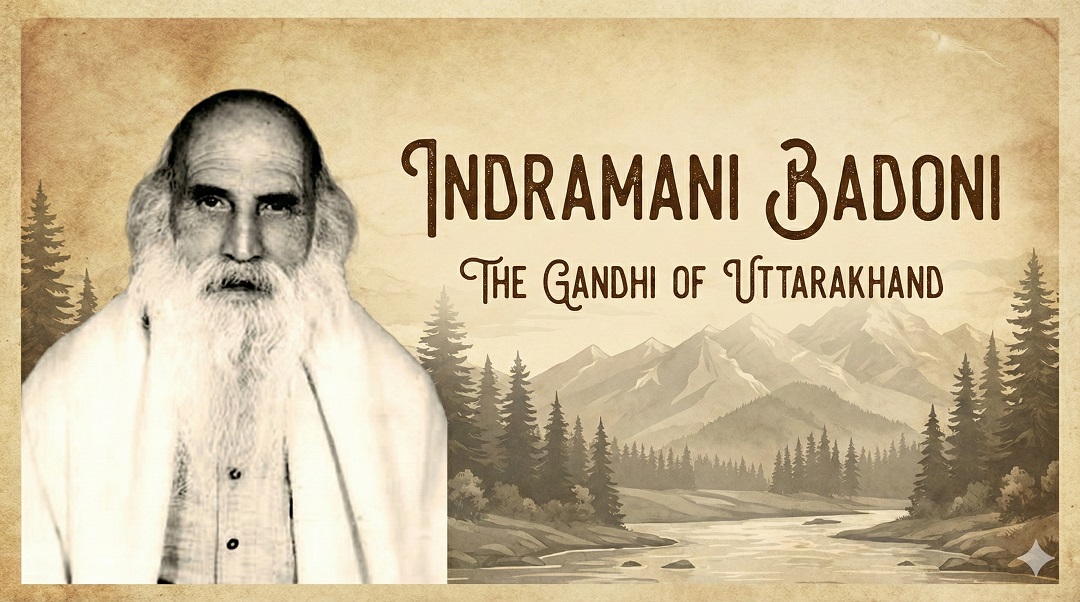
Today, when we walk the streets of Dehradun or gaze at the sunset in Gairsain, we owe a debt to a man who wore simple Khadi, walked barefoot across mountains, and fought the mighty establishment with nothing but the weapon of Ahimsa (Non-violence).
Known to the world as the “Gandhi of Uttarakhand“, Badoni Ji was not just a politician, he was the soul of the Uttarakhand Rajya Andolan.
This is the complete story of the simple goat herder from Tehri who forced Delhi to bow down to the demands of the mountain people.
Early Life and Education of Indramani Badoni
Indramani Badoni was born on December 24, 1925, in the small village of Akhodi in Tehri Garhwal. He was the son of Kaldi Devi and Sureshanand Badoni.
His father passed away when he was very young, so the responsibility of the family came to him at an early age. To support his family, he started grazing goats. This humble work helped him understand the daily struggles and roots of the common hill people.
Despite these difficulties, he completed his schooling in the village and later graduated from DAV PG College, Dehradun in 1949.
Cultural Contribution: Promoting Kedar Nritya and Folk Art
Indramani Badoni was a true lover of culture (Sanskriti Premi) long before he entered politics. He strongly believed that saving our culture is essential to saving our identity. He was an expert in Kedar Nritya (Pandav Nritya), a traditional dance form of Garhwal.
In 1956, he led a cultural group to perform at the Republic Day Parade in New Delhi. Prime Minister Jawaharlal Nehru enjoyed the performance so much that he joined the group and danced along with Badoni Ji. This historic moment brought the folk culture of Garhwal to the national stage for the first time.
Political Career and the Famous ‘One Rupee’ Election
Badoni Ji’s entry into politics was not for power, but for Sewa. He started from the very bottom as a Gram Pradhan and later became the Block Pramukh of Jakholi in 1961.
His popularity was such that he was elected to the Uttar Pradesh Legislative Assembly three times (1967, 1969, and 1977) from the Devprayag constituency.
The “One Rupee” Election Myth
In today’s world, where elections cost crores, Badoni Ji is remembered for his absolute honesty. There is a famous story that during one election, he had no money to campaign. He had arguably just one rupee in his pocket.
But the people of the hills loved him so much that they funded his campaign, fed him, and ensured his victory against wealthy opponents. He proved that a leader needs Neeyat, not just notes.
Role of Indramani Badoni in the Uttarakhand Statehood Movement
The demand for a separate hill state had been simmering for years, but it was Indramani Badoni who turned it into a mass revolution. He joined the Uttarakhand Kranti Dal (UKD) in 1980 and dedicated his remaining life to the cause.
-
The Historic Padyatra from Tawaghat to Dehradun (1988)
To awaken the people, Badoni Ji undertook a massive 105-day Padyatra (foot march) from Tawaghat (Pithoragarh) to Dehradun. Walking village to village (Gaon-Gaon), he explained to the elderly and the youth why a separate state was necessary for their survival.
-
Declaration of Gairsain as the Capital (1992)
Badoni Ji always believed that the capital of the state should be in the hills. On the auspicious occasion of Makar Sankranti in 1992, at the Bagwal fair in Bageshwar, he symbolically declared Gairsain as the capital of the future state. This sowed the seed for the Gairsain sentiment that remains alive today.
-
Hunger Strike of 1994 and its Impact on the Agitation
The defining moment of the movement came on August 2, 1994. Frustrated by the government’s ignorance, Badoni Ji sat on an Aamaran Anshan at the Pauri Commissioner’s office.
The sight of this elderly man, starving for his people, set the hills on fire. Students, women, and government employees joined the movement. Fearing his growing influence, the administration forcibly lifted him on the night of August 7 and sent him to Meerut Jail and later AIIMS Delhi.
But the spark had already turned into a wildfire, leading to the historic agitations in Mussoorie, Khatima, and Muzaffarnagar.
Death and Legacy of the Mountain Gandhi (Parvatiya Gandhi)
It is a tragedy of our history that the man who fought hardest for Uttarakhand never got to see it on the map.
Indramani Badoni breathed his last on August 18, 1999, at Vithal Ashram in Rishikesh. Just one year and three months later, on November 9, 2000, the state of Uttarakhand was finally born.
The Washington Post once described him as the “Mountain Gandhi”, noting that to see a living Gandhi, one had to travel to the Himalayas of India.
Remembering the Legacy
Today, as we live in a free Uttarakhand, we must ask ourselves: Is this the Uttarakhand Badoni Ji dreamt of?
He wanted a state where the youth didn’t have to migrate (Palayan) for jobs, where our culture was respected, and where the capital sat in the lap of the mountains at Gairsain.
Indramani Badoni was not just a person; he was an ideology. He taught us that a simple man from a village in Tehri can shake the corridors of power if his will is strong. It is our duty now to keep his values alive.
Jai Badoni! Jai Uttarakhand!