
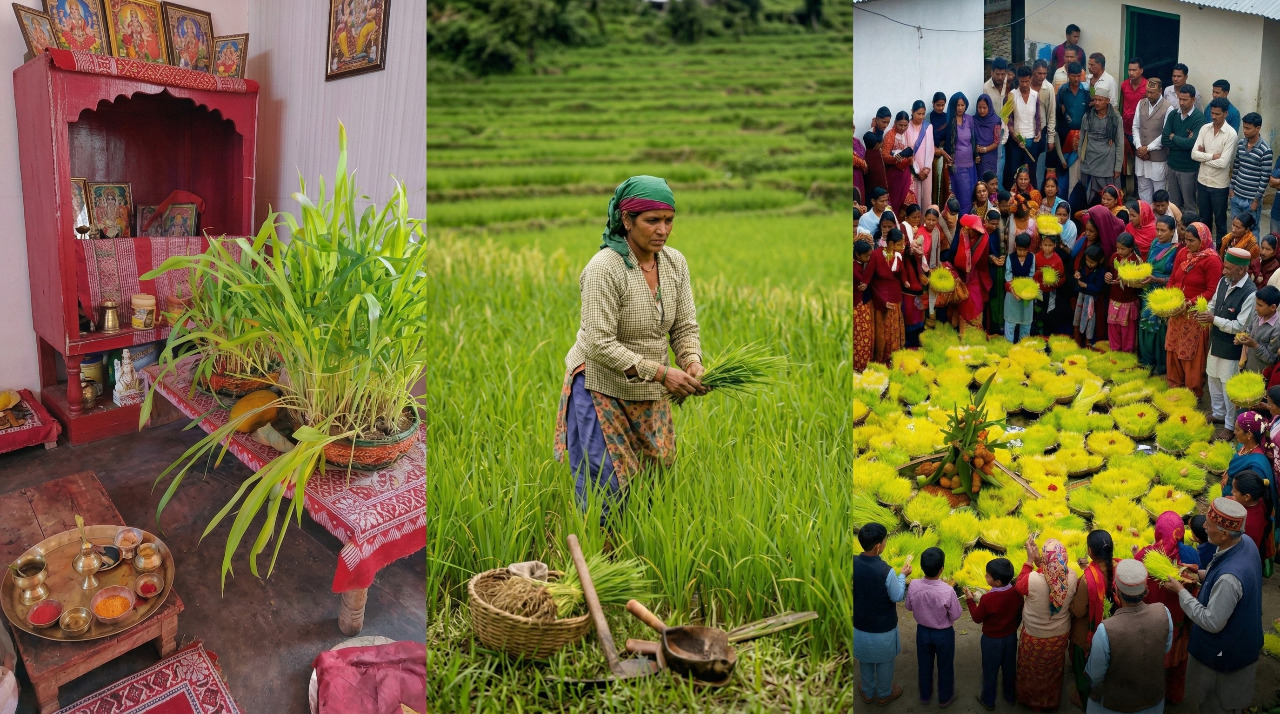
Close your eyes for a moment. Imagine waking up before dawn in a small home nestled in the hills of Almora or Nainital. The air is cool, carrying the faint smell of wet earth and pine. Your grandmother is already awake, humming softly as she carefully cuts tiny green shoots from a mud pot sitting on the windowsill.
She walks toward you slowly, places those fresh green blades on your head, then traces them from your head down to your feet, and whispers a blessing you have heard every year since you were born:
Jee raye, jagu raye, teri umra badi hoye… (May you live long, may you prosper, may your life grow like these green shoots…)
That is Harela. Not just a festival. A feeling. A memory. A promise between the land and the people who love it.
So, what is Harela festival, exactly?

Harela is a traditional Hindu harvest festival celebrated with deep devotion in the Kumaon region of Uttarakhand. The word Harela comes from the Kumaoni word Hareet, meaning green. Literally translated, Harela means Day of Green, a day when greenery, growth, and gratitude take center stage.
It is an agricultural and spiritual celebration that marks the beginning of a new sowing season, honors the bond between humans and nature, and seeks divine blessings for a bountiful harvest ahead.
But Harela is far more than seeds and soil. It is the festival where Kumaoni families come together, where elders bless the young, where clay idols are lovingly crafted by hand, where traditional food fills every kitchen, and where the mountains themselves seem to breathe a little easier.
For every Kumaoni, whether living in the hills of Pithoragarh or the streets of Delhi, whether settled in London or Vancouver, Harela is the festival that pulls them home, if not in body, then always in heart.
This article is your complete guide to understanding Harela: what it is, why it is celebrated, how it is observed, when it falls in 2026, and why every Indian should know about this extraordinary festival from the mountains of Uttarakhand.
Where is the Harela Festival celebrated?
Harela is the heartbeat of the Kumaon region of Uttarakhand, a region that includes the districts of Nainital, Almora, Pithoragarh, Bageshwar, Champawat, and Udham Singh Nagar. It is in these mountains, valleys, and villages that Harela is celebrated with the most passion, the most tradition, and the most joy.
Which districts celebrate Harela most vibrantly?
- Almora: considered the cultural capital of Kumaon, Almora’s Harela celebrations are especially traditional and community-driven.
- Nainital: the hills around the famous lake come alive with colour and festivity.
- Pithoragarh: close to the Nepal border, the celebrations here have a unique cross-cultural flavour.
- Bageshwar: a deeply spiritual town where Harela has sacred significance near the Bageshwar temple.
- Champawat: one of the oldest settlements in Kumaon, where ancient Harela customs are still faithfully preserved.
What about Garhwal?
In the Garhwal region of Uttarakhand, a similar celebration exists but goes by different names, Mol-Sankranti or Rai-Sagran. Harela as a name and as a practice is primarily rooted in Kumaoni culture. This distinction matters because Kumaon and Garhwal, while both part of Uttarakhand, have distinct cultures, dialects, and festival traditions that are each worth celebrating.
Beyond Uttarakhand
Harela is also observed in parts of the Mahasu region of Himachal Pradesh, where it is called Hariyali or Rihyali in Kangra, Shimla, and Sirmaur districts, and Dakhrain in Jubbal and Kinnaur.
And then there is the Kumaoni diaspora, the millions of Uttarakhandis living across India’s cities and abroad. In Delhi, Mumbai, Pune, London, the United States, Canada, and the Middle East, Kumaoni communities come together every year to celebrate Harela with the same love and devotion they grew up with. A piece of home, carried across the world in a pot of sprouting seeds.
Why is Harela Celebrated?
The answer lives at the intersection of agriculture, spirituality, ecology, and community, four threads woven so tightly together in Kumaoni culture that you cannot pull one without feeling all the others.
The Agricultural Root
Kumaon has always been a land of farmers. The terraced fields carved into the hillsides, locally called seeri, have fed families for generations. For these farming communities, the rhythm of life is the rhythm of crops: sowing, growing, harvesting, and beginning again.
Harela marks the beginning of each new sowing cycle. It is the moment when the community collectively says: we are ready. The earth is ready. Let us begin.
By sowing seeds a few days before the festival and watching how well they sprout, farmers have traditionally been able to assess the quality of their stored seeds and the readiness of the soil. A lush, tall Harela is considered a sign of an abundant harvest to come.
The Spiritual Significance
Harela, especially the most celebrated Shravan Harela, is deeply connected to Lord Shiva and Goddess Parvati. The festival is observed as the wedding anniversary of the divine couple, a day when their union brought fertility, prosperity, and joy to the world.
In Uttarakhand, which is known as Devbhoomi (Land of the Gods), Lord Shiva is not merely a deity to be worshipped from a distance, he is a neighbour, a mountain dweller, a farmer at heart.
The Shravan month (July) is especially sacred to Lord Shiva, and Harela in this month carries a particularly deep religious resonance. But across all three Harela celebrations, the spiritual thread is the same: gratitude to the divine forces that make life, growth, and harvest possible.
The Ecological Message
Long before the world began talking about sustainability, the people of Kumaon were practising it. Harela has always carried a powerful ecological message. The very act of sowing seeds, nurturing them, and then planting trees on the festival day is a centuries-old lesson in living in harmony with nature.
In recent decades, the Uttarakhand government and various NGOs have embraced Harela as a platform for environmental awareness, organizing mass tree-plantation drives, school programs, and community green campaigns around the festival. Schools across Kumaon encourage students to plant saplings as part of their Harela celebrations.
The Social Bond
Perhaps the most beautiful reason Harela is celebrated is the simplest: it brings people together. Families reunite. Neighbours share food. Elders place green shoots on the heads of children and bless them. Newly married daughters receive gifts from their parents (a tradition called Bhitauli or Bhaitauli). Bullocks are given a day of rest. Even animals are honoured.
Harela is, at its core, a celebration of the relationships that sustain us, with the land, with the divine, and with each other.
Harela Celebrated Thrice a Year
Here is something that surprises many people outside Kumaon: Harela is not celebrated just once a year. It is celebrated three times, once in each major season.
This is the detail that makes Kumaoni culture so extraordinarily rich. The three Harelas correspond to three critical moments in the agricultural and ecological calendar:
Chaitra Harela: March/April (The Spring Harela)
Celebrated during Chaitra Navratri (the nine days of the spring Navratri, falling in March-April), this Harela marks the arrival of summer and the beginning of the new crop cycle. Seeds are sown on the first day of Chaitra Navratri and harvested on the ninth day (Navami).
In 2026, Chaitra Navratri ran from March 19 to March 27, meaning Chaitra Harela 2026 was celebrated on March 27, just recently concluded. This is the Harela connected to new paddy crop seeding in the region, as farmers prepare for the coming growing season. It is observed primarily through women sowing seven types of grains in baskets, a ritual of hope and anticipation.
Shravan Harela: July 16 (The Monsoon Harela)
This is the most famous and widely celebrated of the three Harelas, and what most people mean when they simply say Harela. It falls on the first day of the Hindu month of Shravan (also called Sawan), in 2026, this falls on July 16.
Seeds are sown nine to ten days in advance, in the month of Ashadha, and harvested on the first day of Shravan. The Shravan Harela marks the arrival of the monsoon, the beginning of the most important paddy growing season, and the wedding anniversary of Lord Shiva and Parvati.
It is celebrated with the greatest fanfare, with clay Dikare idols, community feasts, and the quintessential ritual of elders placing green shoots on family members’ heads.
Ashwin/Sharad Harela: September/October (The Autumn Harela)
Celebrated during Sharad Navratri (the autumn Navratri), seeds are sown on the first day of Navratri and harvested on Dashahara (the tenth day). This Harela marks the onset of winter and is associated with post-monsoon harvest gratitude. It is slightly less widely observed than the Shravan Harela but carries equal spiritual significance, particularly in terms of thanking the divine for the monsoon harvest.
Each of these three Harelas is a weather forecast and a farmer’s diary written in the language of seeds and soil. Together, they form a complete circle, spring, monsoon, autumn, a year of hope, hard work, and gratitude.
How is Harela Celebrated? Rituals, Traditions & the Magic of the Day
If you truly want to understand Harela, you need to walk through the rituals day by day. The celebration does not happen in a single morning, it is a process that unfolds over nine to ten days, building quietly to a joyful, blessed conclusion.
Sowing the Seeds (9–10 Days Before the Festival)
The celebration begins quietly, in the hands of the women of the household. A flat wicker basket, a mud pot (called dolu), or a wide earthen thali is filled with soil. Into this soil, women sow five to seven types of seeds, a mix that typically includes wheat, barley, maize, mustard, horse gram, soybeans, rice, and sometimes sesame. These are called Navadhanyas (nine grains) in some traditions.
The seeds are watered daily with care and devotion, kept in a sheltered corner of the home, away from direct sunlight so the shoots grow pale yellow and tender, a specific characteristic of true Harela shoots. The entire household watches the progress of these little seedlings as the days pass.
A common belief: the taller and lusher the Harela shoots grow, the more abundant the coming harvest will be. A household with tall, healthy Harela is a household with good fortune ahead.
Crafting the Dikare (The Clay Idols)
In many homes across Kumaon, an extraordinary tradition takes place in the days leading up to Harela: the crafting of Dikare (also called Dikars). These are small, lovingly made clay idols of Lord Shiva, Goddess Parvati (Gauri), Lord Ganesha, and Maheshwar, a symbolic representation of the divine family.
The idols are not bought from shops. They are made by hand, by members of the household, often children and women, shaped from local clay, decorated with natural colours, and set out to dry. On the day of Harela, these Dikare are worshipped together with the green shoots. There is something profoundly moving about a festival where the devotional objects are made, not purchased, where the sacred comes from your own hands.
Preparing and Blessing
On the evening before the main festival day, the Harela shoots are carefully cleaned and tied into two small bundles. They are adorned with a tilak, seasonal fruits, and traditional dishes. The Pandit ji performs a Pranpratishtha, a ceremony of invoking the divine presence, over the Harela and the Dikare at the local Devasthanam (temple).
Homes are thoroughly cleaned. Women draw Aipan, traditional Kumaoni folk art, on walls, doorways, and floors using red ochre and white rice paste. This geometric art form is unique to Kumaon and transforms every home into a living canvas for the festival.
The Morning of Harela
The main day begins before sunrise. The family gathers. The priest completes the morning rituals. Then comes the moment the entire household has been waiting for: the elders place Harela on the heads of the younger members.
The grandmother, grandfather, mother and father, takes the fresh green Harela shoots and places them gently on the head of each family member, drawing them slowly from the head down to the feet. As they do this, they chant traditional Kumaoni blessings:
Jee raye, jagu raye, teri umra badi hoye, daana paani ki kami na hoye… (May you live long, may you be prosperous, may you never lack food or water…)
These words, spoken in the gentle morning light of a Kumaoni home, are perhaps the most beautiful thing about Harela. The shoots are also placed behind the ears, and some are sent in letters or packets to relatives and friends who cannot be present, a tradition of sharing the blessing across distance.
Traditional Kumaoni Food
After the rituals, the kitchen comes alive. Harela is a day of feasting, and Kumaoni kitchens prepare special dishes including aloo ke gutke (spiced potatoes), bhatt ki churkani (black soybean curry), jhangora ki kheer (barnyard millet pudding), bal mithai (Kumaon’s beloved chocolate-brown sweet), and singori (khoya wrapped in maalu leaves). The seeds of the harvested Harela crop are also roasted and eaten, a ritual tasting of the new harvest.
The bullocks, the farmer’s most faithful companions, are given a day of rest on Harela. Even the animals are included in the celebration.
Planting Trees
On the day of Harela, many families plant a sapling or a branch of a tree. A beautiful local belief holds that any branch planted on Harela day will take root and grow strong, that the auspiciousness of the day gives the plant the will to survive. This tradition of tree planting on Harela has been embraced and amplified in recent decades into large-scale environmental campaigns across Uttarakhand.
Bhitauli
Following Harela comes Bhitauli (also called Bhaitauli, a tradition where parents send gifts of money, clothing, and sweets to their married daughters, and brothers send presents to their sisters. In a society where women often marry into distant households in the hills, Bhitauli is an act of love that says: we have not forgotten you. You are still ours.
Harela Festival 2026: Dates, Significance
If you are searching for Harela festival 2026, here are the key dates to note:
- Chaitra Harela 2026: Seeds sown: March 19 | Harvest and celebration: March 27, 2026 (Celebrating Today)
- Shravan Harela 2026: Seeds sown: ~July 6 | Main celebration: July 16, 2026 (Kark Sankranti / First day of Shravan)
- Ashwin/Sharad Harela 2026: Seeds sown: First day of Sharad Navratri (October 2026) | Harvest: Dashahara, October 2026
The Shravan Harela on July 16 is the one to mark on your calendar if you wish to experience the festival in its full, vibrant form. This is when celebrations are largest, most colorful, and most community-driven.
What to expect during Shravan Harela 2026
The Uttarakhand government typically organizes large tree-plantation drives, cultural programs, and state-level events to mark Harela. Schools host Harela-themed activities, art competitions, and sapling distribution drives. In towns like Almora, Nainital, and Bageshwar, local melas (fairs) and community gatherings create a festive atmosphere that lasts several days.
Harela and the Environment
Long before climate change became a global conversation, the people of Kumaon already understood, in their bones, what it meant to live with the land rather than against it.
The hills of Uttarakhand are not just scenery. They are the source of India’s great rivers, the Ganga, the Yamuna, the Saryu, the water that feeds a nation. The forests of Kumaon are the lungs of northern India. And the farmers of this region have always known that their survival depends entirely on the health of the land around them.
Harela embodies this wisdom. Every ritual is an act of ecological relationship, sowing seeds with care, growing them with attention, planting trees with intention. The belief that a tree planted on Harela will take root and live forever is not superstition. It is an ancient incentive system designed to keep the hills green.
Harela and the Chipko Movement
The connection between Kumaon’s ecological consciousness and the famous Chipko Movement, where villagers, primarily women, embraced trees to prevent them from being felled by contractors in the 1970s, is no coincidence. A culture that celebrates greenery three times a year as a sacred act is a culture that will stand between a chainsaw and a forest without hesitation.
Government initiatives
The Uttarakhand government has formally recognized Harela’s environmental significance. Large-scale plantation drives organized around Shravan Harela plant lakhs of trees across the state every year. The message is clear: Harela is not just Kumaon’s festival. It is Uttarakhand’s green conscience, and India’s reminder that sustainable living is not a modern invention. It is a very old Kumaoni tradition.
Keep the Harela Spirit Growing
There is an old Kumaoni saying that the hills remember everything. The festivals, the songs, the blessings, they are written into the land itself.
Harela is one of those festivals that India deserves to know, not as a curiosity from a distant mountain region, but as a living, breathing lesson in how to celebrate life, honor nature, and care for each other.
In a world struggling with climate change, broken communities, and forgotten roots, Harela speaks with remarkable clarity: tend your soil. Bless your children. Plant a tree. Come home.
Whether you are a Kumaoni carrying the hills in your heart from thousands of miles away, a traveller curious about the quiet festivals of the Himalayas, or simply an Indian who wants to understand their country a little better Harela has something to offer you.
The next time Shravan Harela arrives on July 16, 2026, find a small pot. Fill it with soil. Sow a few seeds. Watch them grow. And when the shoots are tall and green, place them gently on the heads of the people you love.
That is Harela. And once you have felt it, you will never forget it.