
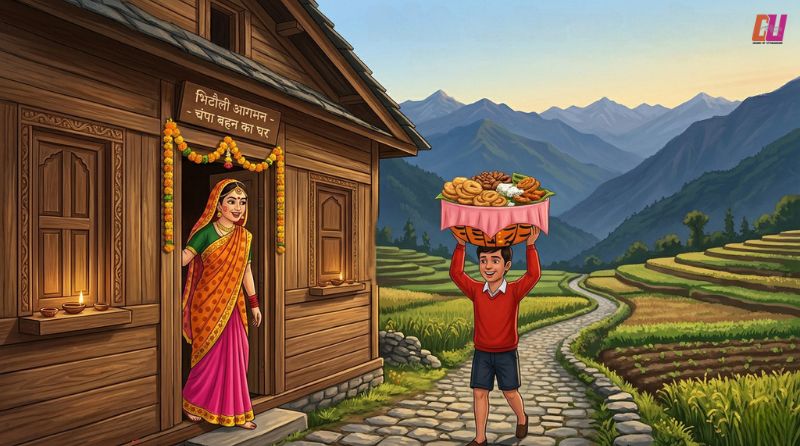
In the Himalayas, where distances are long and roads are winding, a tradition survives that no modernity has been able to replace the simple act of a brother walking miles to knock on his sister’s door, just to remind her she is not forgotten. This is Bhitauli.
What is Bhitauli Tradition of Uttarakhand?
If you have heard of Raksha Bandhan or Bhai Dooj, you already know that India holds the sibling bond sacred. But nestled in the hills of Uttarakhand lives a tradition that is quieter, older, and perhaps even more emotionally profound, Bhitauli (भितौली), also spelled Bhaitauli, Bhitoli, or Bhitouli.
Bhitauli is a centuries-old folk tradition practiced in the Kumaon and Garhwal regions of Uttarakhand, where every year during the Hindu month of Chaitra (March-April), a married woman’s natal family, her parents, brothers, and relatives, travels to her in-laws’ home bearing gifts of love such as clothes, homemade sweets, fruits, and blessings.
The word Bhitauli comes from the Hindi word भेंट (bhet), meaning ‘meeting or gift.’ But no dictionary definition can fully capture what this tradition really is, it is an annual promise from a family to their daughter and sister that she has not been left behind.
The Origin and History of Bhitauli
The exact historical origins of Bhitauli are, like most living folk traditions, difficult to trace to a single point in time. Scholars and cultural historians believe it evolved organically from the agrarian lifestyle of Uttarakhand’s hill communities, where the rhythm of life was deeply tied to seasons, sowing, and harvest.
In the hills of Kumaon and Garhwal, daughters are married off into distant villages, sometimes many hours or even a day’s walk away. In earlier times, without roads, phones, or motor vehicles, a married woman could spend months without seeing her family.
The tradition of Bhitauli was born from this geography of separation. It was the community’s way of ensuring that no married daughter felt abandoned, that she received not just gifts but the warmth of her family’s presence at least once a year.
The tradition aligns with Chaitra Navratri and the Harela festival, the spring sowing season, making it a celebration that weaves together agricultural hope and familial love. As seeds are planted in the earth and the hills turn green, families are also renewed in their bonds.
The Legend of Debuli and Nariya
Every meaningful tradition carries a story in its heart. Bhitauli’s soul is kept alive by a hauntingly beautiful folk legend, the tale of Debuli and Nariya.
Nariya was a devoted brother who walked long miles through forests and hills to visit his married sister Debuli. He arrived late at night and, not wanting to wake her, quietly placed all the gifts he had brought at her doorstep. Hungry and tired from his long journey, he turned around and began walking back home without ever entering.
When Debuli woke at dawn, she found the gifts and immediately recognized her brother’s love in them. She ran out searching for him, her heart filled with both joy and anguish, only to find he had already gone. She was overcome with grief when she realised that “Bhai bhukha raha”, her brother had left hungry, that he had not even waited to eat the meal she would have lovingly prepared.
The grief was too great. Debuli died of sorrow.
In the legend, Debuli is reborn as the Ghughuti bird (a type of dove native to the Kumaon hills), whose call during Chaitra is believed to echo her eternal lament. This is why the Kumaoni folk song goes:
न बासा घुघुती चैत की, याद ऐ जांछी मिकें मैत की
(Do not call, O Ghughuti, in the month of Chaitra, your call reminds me of my home)
This legend isn’t just a story. It is the emotional DNA of Bhitauli, it explains why brothers must not just send gifts but must come in person, must eat the food their sister has cooked, must stay long enough to feel at home. The tradition is a living act of correcting Nariya’s mistake, year after year.
When is Bhitauli Celebrated?
Bhitauli is celebrated primarily during the Hindu month of Chaitra, the first month of the Vikram Samvat calendar, which is the traditional lunisolar calendar followed across Uttarakhand and much of India, falling in March-April by the Gregorian count.
This coincides with the onset of spring in the Himalayas, when the rhododendrons bloom red on the hillsides, the air is fragrant, and the forests turn lush.
For newly married women, the first Bhitauli is often received in the following month of Baisakh (April–May), a grace period recognizing that the family may need a little more time after the wedding. After this, every year without fail, Chaitra brings Bhitauli.
The tradition also sometimes occurs during Shravan (July–August) and the Sharad Navratri (September–October), but Chaitra remains the primary and most emotionally significant time.
Where is Bhitauli Celebrated?
Bhitauli is rooted in the hilly districts of Uttarakhand, particularly:
- Kumaon Division: Nainital, Almora, Bageshwar, Pithoragarh, Champawat, Udham Singh Nagar
- Garhwal Division: Tehri Garhwal, Pauri Garhwal, Chamoli, Rudraprayag, and parts of Dehradun
While Kumaon is considered the heartland of this tradition, it is celebrated with equal warmth across the Garhwal region. The tradition is not caste-specific or community-specific, it belongs to everyone in the hills.
How is Bhitauli Celebrated? The Rituals and Customs
Unlike many Indian festivals that involve temple processions, fire rituals, or large public gatherings, Bhitauli is profoundly intimate. It happens in small courtyards, at kitchen hearths, and across family dining mats. Its grandeur is not visual, it is emotional.
The Brother’s Journey
The centerpiece of Bhitauli is the brother’s visit. He sets out from his home, sometimes walking through pine forests, crossing narrow mountain bridges, taking bus rides on winding roads, carrying a bundle of gifts wrapped carefully in cloth. The gifts typically include:
- New clothes: A saree, suit, or outfit for the sister
- Traditional Kumaoni sweets: Bal Mithai (a chocolate-brown fudge coated in sugar pellets), Singhal (deep-fried sweet spirals), and Arsa
Seasonal fruits. - Dry fruits and nuts
- Items for the kitchen or home
- Cash or monetary gifts, especially in modern times
Importantly, the gifts are also sent from parents and other family members, making Bhitauli a collective act of familial love, not just a sibling ritual.
The Sister’s Preparation
On her end, the married sister prepares for the visit with great anticipation and care. The house is cleaned, the courtyard swept, and traditional dishes are lovingly cooked:
- Kheer
- Puri
- Pua (sweet fried pancakes)
- Pakori
- Khichdi: Simple, warm, home-style rice and lentils
The act of cooking is itself symbolic. The sister feeds her brother, and that shared meal, the meal that Debuli never got to give Nariya, is the true heart of Bhitauli.
Folk Songs and Storytelling
No Bhitauli celebration is complete without Kumaoni folk songs (lok geet). Women sing songs of longing for the maternal home, songs celebrating sibling love, and songs that tell the story of Debuli and Nariya. These are not performed for an audience, they are sung spontaneously, often with tears and laughter together.
Families gather, stories are shared, and for a few precious hours, the married daughter is returned, emotionally if not physically, to her maayka (maternal home).
Bhitauli and the Lives of Uttarakhand’s Women
To truly understand the cultural weight of Bhitauli, one must understand the life of a woman in Uttarakhand’s hills.
The hill communities of Uttarakhand have long been shaped by male out-migration, men leave villages to find work in cities, leaving behind wives and mothers who manage the household, the children, the fields, and the livestock almost entirely on their own. The terrain is demanding, the roads are long, and a married woman’s visits to her natal home are rare.
For such women, Bhitauli is not merely a festival, it is a lifeline. It is the annual proof that her family still thinks of her, still travels for her, still loves her. The gifts matter, but what matters infinitely more is the face at the door.
The famous folk song captures this longing perfectly, when the Ghughuti bird calls in Chaitra, the married woman is reminded of her maayka, and the wait for Bhitauli becomes almost unbearable in its sweetness.
Bhitauli and Harela: The Twin Festivals of Chaitra
Bhitauli is deeply intertwined with Harela, another beloved tradition of the Kumaon region. Harela is an agricultural festival where, on the first day of Chaitra Navratri, women sow seven types of grains in small earthen pots. These germinate over nine days into yellow shoots (called Harela), which are then harvested on the tenth day and placed behind the ears and on the heads of family members as a blessing for good harvest and prosperity.
Together, Bhitauli and Harela form a beautiful cultural pairing, Harela celebrates the earth’s fertility; Bhitauli celebrates human bonds. One looks to the field, the other to the family. Both remind the people of Uttarakhand of what sustains life.
Why Bhitauli Deserves a Place in India’s Cultural Conversation
India celebrates Raksha Bandhan on a national scale, a thread on the wrist, a box of sweets, a promise of protection. It is beautiful. But Bhitauli does something that Raksha Bandhan does not: it goes to the woman. The brother walks to her. The family travels to her. She does not have to return; they come.
In a country where daughters are often considered paraya dhan (someone else’s wealth) once married, Bhitauli is a radical act of love, it insists that a married woman remains precious to her natal family, that she is visited, gifted, fed, and sung to every single year.
This is why Bhitauli is not just a local tradition. It is a living cultural philosophy, one that every corner of India could learn from.
Bhitauli: A Tradition Worth Protecting and Celebrating
In a world that moves fast and forgets easily, Bhitauli is a deliberate act of slowness and memory. It is the Himalayas’ answer to a question the rest of India rarely thinks to ask: What does it feel like to be a married daughter far from home?
And the hills answer: You are not forgotten. We are coming.
As Uttarakhand modernises, as its villages empty and its young migrate to cities, traditions like Bhitauli serve as cultural anchors, reminding people of who they are, where they come from, and what they owe each other.
At Colors of Uttarakhand, we believe that knowing these traditions is the first step to preserving them. Share this article with someone who loves Uttarakhand, or with someone who has never heard of it. Because the story of Bhitauli, of Debuli’s grief, Nariya’s quiet love, and the Ghughuti bird’s eternal call, deserves to be known far beyond the hills.