
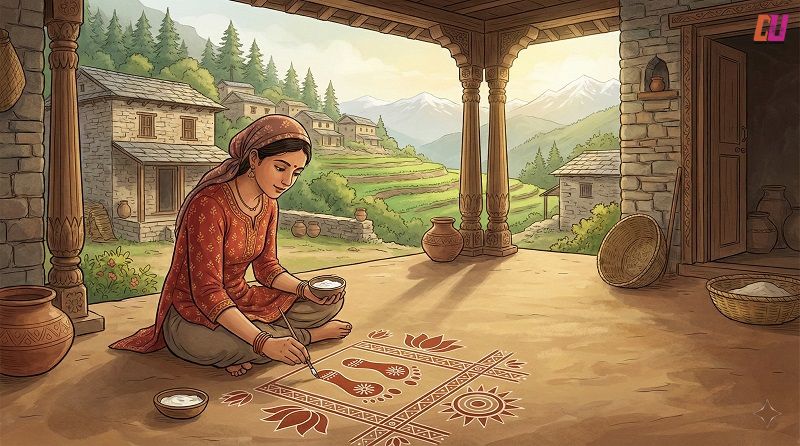
As a native of Uttarakhand, I have watched my grandmother and mother meticulously prepare the Geru and Biswar every Diwali. For Pahadis, Aipan is more than an art form, it is a ritualistic invocation of the divine, symbolizing prosperity and protection.
Whether you are an art student researching different art forms of Uttarakhand or a cultural enthusiast wanting to try your hand at Aipan drawing, this article combines historical depth with practical steps to master this timeless tradition.
Aipan Folk Art of Uttarakhand
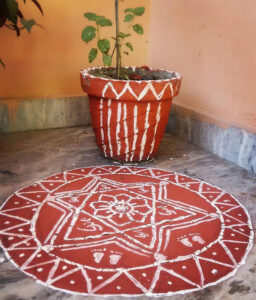
The word Aipan is derived from the Sanskrit word Lepana (to plaster) or Arpan (to dedicate/offer). While it is generally categorized under the folk art of Uttarakhand, it is specifically indigenous to the Kumaon region.
Unlike generic rangoli found elsewhere in India, Kumaoni Aipan art is permanent and deeply symbolic. It is drawn on the (Dehri) of homes, in courtyards, and around the temple area.
The art form relies on a powerful dual-color scheme:
- Red (Geru): Represents the earth, energy, and the material world.
- White (Rice Paste): Represents purity, peace, and the divine.
While it was traditionally done on mud floors, the adaptability of Aipan art has seen it survive the transition to modern cemented houses, fabrics, and even digital canvases. However, its core purpose remains the same: to welcome the gods and ward off negative energy.
History of Aipan Art and Kumaoni Culture
To understand the designs, we must first look at the Aipan art history. This tradition is believed to have originated in Almora during the reign of the Chand Dynasty in Kumaon (approx. 7th to 18th century AD). It was a golden era where art and architecture flourished in the Himalayas.
The history of Aipan art is intrinsically linked to the women of Kumaon. For centuries, this art has been a matrilineal heritage, passed down from mothers to daughters and mothers-in-law to daughters-in-law. There were no textbooks, the patterns were memorized and mastered through observation.
In the Aipan art of Uttarakhand, the motifs were originally inspired by nature, flowers, leaves, and animals. Over time, these evolved into complex geometric patterns incorporating cosmic elements and deities.
Traditional Aipan Art Materials and Tools
One of the most beautiful aspects of this art form is its simplicity. You do not need expensive acrylics or canvases to begin. The traditional aipan art materials are organic and sourced directly from the earth.
If you are gathering Aipan art materials, here is what constitutes the authentic toolkit:
-
Cow Dung
Before the colors touch the ground, there is a crucial preparation step often missed in modern tutorials. Traditionally, the floor is cleaned and smoothed with a solution of cow dung. This acts as a protective layer and ensures the surface is spiritually purified before the sacred art is drawn.
-
Geru (Red Ochre)
The base of all Aipan is prepared using Geru, a filtered red clay or soil found in the Kumaon hills. It is soaked in water to create a thick, smooth red paint that is applied over the cow dung or floor surface.
-
Biswar (Rice Paste)
The white patterns are created using Biswar. This is made by soaking raw rice overnight and grinding it into a fine, wet paste. The consistency is crucial, it must be fluid enough to flow but thick enough to stand out against the red background.
-
The Anamika
Historically, there was no external Aipan art tool. The women used the tip of their ring finger (Anamika) or simple sticks made from local fibers to draw the dots and lines.
Today, for Aipan art drawing on paper or fabric, artists use modern adaptations like synthetic brushes and acrylic paints to ensure longevity.
Types of Aipan Art Designs and Motifs
When analyzing types of Aipan art, you will find that specific designs correspond to specific occasions. The motifs are carefully chosen to invoke blessings for festivals, weddings, or births.
Here is a breakdown of the most prominent Aipan designs:
-
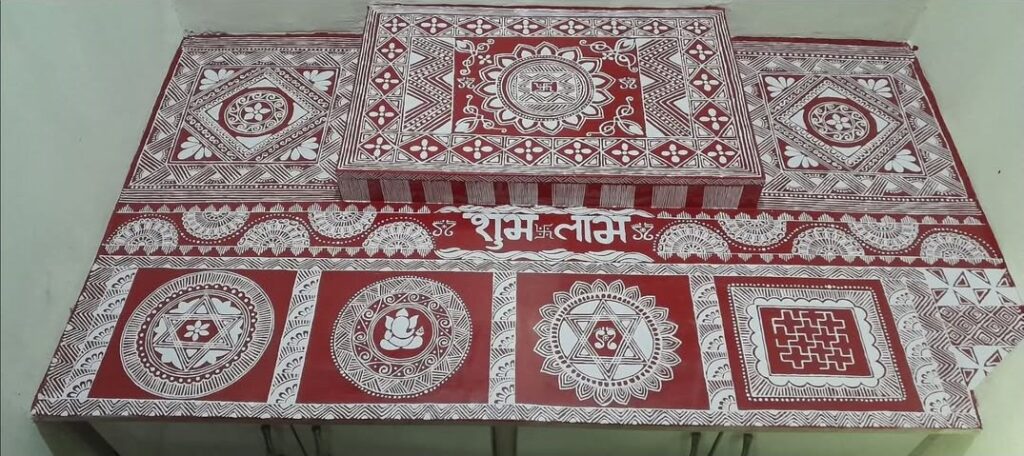
Saraswati Chowki
Dedicated to the Goddess of Knowledge, this design is essential during Vasant Panchami or when a child begins their education.
- The Design: It features a central square or rectangle (the chowki or seat) decorated with lotus motifs, conch shells, and lamps.
- Significance: It creates an auspicious environment for learning and creativity.
-
Mahadurga Pattern
During the nine holy nights of Navratri, the Mahadurga pattern takes center stage.
- The Design: This intricate pattern features a central motif representing Goddess Durga, surrounded by protective geometric shapes like triangles and squares.
- Significance: It is drawn to honor the Goddess’s strength and to ward off negative forces from the home.
-
Dhuli Arghya
This is perhaps the most famous wedding motif. It is a long, vertical design drawn to welcome the groom. As the groom enters, he stands on this design, which symbolizes the status of God Narayan being accorded to him.
-
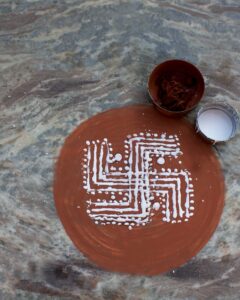
Swastik and Auspicious Symbols
You will often see the Swastik integrated into larger designs. In Aipan, the Swastik represents well-being and spiritual prosperity. Other common elements include:
- Padchinha: Representing the arrival of Goddess Lakshmi or deities.
- The Bindu: Central to many designs, symbolizing the center of the universe and the origin of creation.
-
Aipan Art Border Design and Vasudhara
The Aipan art border design is essential to framing the main motif. But the most critical element of the border is the Vasudhara.
Vasudhara consists of vertical lines dripping continuously.
- The Rule: You must always draw an odd number of lines (5, 7, 9, or 11).
- Significance: These vertical currents represent the continuous flow of wealth and blessings into the home.
How to Make Aipan Art: Step-by-Step Process
Time Required: 45 – 60 Minutes Difficulty: Moderate
Aipan art requires careful preparation and mastery of basic techniques before advancing to intricate designs. Attention to detail and patience are essential, from preparing the base surface to applying the final touches, to preserve the artwork.
Step 1: Prepare the Surface
Traditionally, you would apply a cow dung wash followed by Geru. For a modern project, apply a coat of Red Ochre acrylic paint or Geru on your surface (wood, cardboard, or fabric). Let it dry completely to create a matte red background.
Step 2: Prepare the Biswar
If using traditional methods, grind soaked rice. If you are a beginner, white poster color or acrylic paint works well. Ensure the consistency is like thick milk to allow for the “drip drawing” method.
Step 3: The Bindu
Every Aipan art drawing starts from the center. Place a central dot (Bindu). All geometry radiates from this single point. This ensures symmetry without using a ruler.
Step 4: Drawing the Geometry
Using your brush or finger, begin drawing the inner circle or square. Keep your wrist loose. In Aipan, the lines do not have to be mechanically straight; they should have a rhythmic, organic flow.
Step 5: The Dots
This is the signature of Aipan. Once your lines are drawn, decorate the empty spaces and line junctions with clusters of dots. This gives the art depth and texture.
Step 6: The Borders and Vasudhara
Finish by framing your art with an Aipan art border design and drawing the vertical Vasudhara lines on the outer edges.
Modern Aipan Painting and Decor
In the last decade, there has been a massive resurgence in Aipan painting. The art has moved from the floor to the mantelpiece.
We now see:
- Aipan on Fabric: Sarees, Kurtas, and Dupattas featuring Aipan borders.
- Souvenirs: Coasters, nameplates, and decorative trays using modern fixatives to preserve the design.
- Geographical Indication (GI) Tag: Efforts are underway to promote and protect Aipan with a GI tag, ensuring the authenticity of products sold in the market.
-
Preservation and Community
This revival is largely driven by women. Many have formed collectives and NGOs to formalize training. Government schemes and workshops are now teaching these skills to the younger generation, turning a ritual into a sustainable livelihood and tourism attraction.
Conclusion
Aipan is not just a pattern of red and white; it is the heartbeat of Kumaon. It represents the patience of our ancestors, the sanctity of our homes, and the richness of Uttarakhand culture.
From the humble cow dung base to the intricate Mahadurga patterns, every step of this art form tells a story of devotion. Whether you are looking to create a traditional Aipan design for Diwali or simply studying the different art forms of Uttarakhand, remember that every dot and every line carries a prayer.