
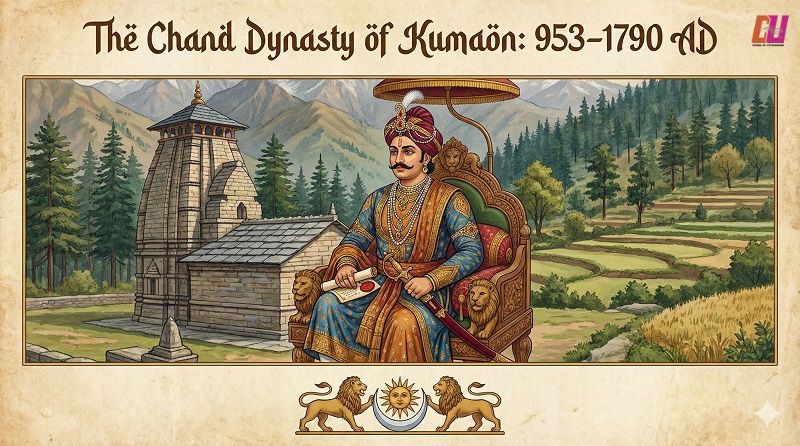
The Chand Dynasty ruled the Kumaon region from approximately 953 to 1790 AD, establishing a significant kingdom after the decline of the Katyuri rulers.
This dynasty, founded by Som Chand, played a crucial role in shaping the cultural and political landscape of present-day Uttarakhand and parts of western Nepal.
Their reign stretched over eight centuries, marked by territorial expansion, administrative innovations, and contributions to art and local governance.
Under the Chand kings, Kumaon flourished, with the capital initially set in Champawat. The dynasty witnessed notable rulers like Raja Baz Bahadur Chand, who expanded their territory by capturing key regions including Dehradun.
The Chand period was also defined by the introduction of structured village administration, a tradition that impacted local society for generations.
The dynasty’s rule came to an end in 1790 when the Gorkhas of Nepal defeated the last Chand king, Mahendra Chand. Their long-lasting influence remains evident today in the historical identity and cultural heritage of Kumaon, making their story an essential part of Uttarakhand’s past.
Origins of the Chand Dynasty
The Chand Dynasty emerged in the early second millennium, establishing a significant rule in the Kumaon region. Its founder laid the groundwork for a lasting political and cultural influence, inheriting a lineage with historical ties to northern Indian royal houses. The dynasty’s territorial base expanded steadily within Kumaon, leveraging strategic geography for its capital and control.
Founding of the Dynasty
The Chand Dynasty was founded by Som Chand around the late 10th or early 11th century CE. Som Chand originated from the area near present-day Jhusi and moved northward, eventually displacing the declining Katyuri rulers in Kumaon. He established his capital at Rajbunga, present-day Champawat, chosen for its strategic location in the hills.
This founding marked the end of Katyuri dominance and the beginning of Chand control, which continued for nearly eight centuries. Som Chand’s consolidation of power provided stability in a region that until then was fragmented.
Lineage and Ancestry
The Chand rulers claimed descent from the Somavanshi (Lunar) dynasty and identified as Rajputs, linking themselves to the ancient Raghuvanshi lineage. This connection enhanced their royal prestige and legitimacy.
Historical accounts indicate that Som Chand might have had ties with the Chandel House of Chanderi, a prominent northern Indian dynasty. This genealogy was important in affirming their status as rulers among the Rajput clans and projecting authority in the regional political landscape.
Geographical Rise in Kumaon
The Chand Dynasty’s early domain centered in the rugged terrain of Kumaon, which includes present-day Uttarakhand. Their capital, Rajbunga, was strategically located on a ridge flanked by rivers and surrounded by hill ranges, facilitating defense and control over trade routes.
Over time, the Chand rulers expanded their influence across Kumaon, extending into the Terai plains and at times reaching parts of western Nepal. This geographical expansion allowed them to control both mountainous and fertile lowland regions, strengthening the dynasty economically and militarily.
Political Expansion and Conquests
The Chand dynasty established its influence through a series of strategic expansions and military ventures. They secured and extended their rule over Kumaon and beyond by reinforcing control of key territories and engaging in campaigns against neighboring powers.
Early Territorial Expansion
The foundation of Chand rule began with Som Chand in the 10th century, who displaced the declining Katyuri kingdom. This initial conquest focused on capturing the core Kumaon region, particularly the fertile valleys and important passes. The dynasty quickly consolidated power by establishing Almora as its capital in the 16th century, chosen for its defensible geography surrounded by hill ranges and rivers.
Internal administration reforms supported territorial consolidation. The dynasty prioritized local alliances and built fortifications to secure borders. These efforts facilitated control over the mountainous terrain, which was crucial given the region’s fragmented political landscape.
Major Military Campaigns
Throughout its history, the Chand dynasty engaged in multiple military campaigns to defend and expand its borders. Their armies were organized with a focus on mountain warfare, including the use of forts and tactical guerrilla methods appropriate for the rugged Kumaon landscape.
Significant battles were fought against the remnants of other Himalayan rulers and external threats such as the Gorkhas of Nepal. One of the last and decisive confrontations occurred in 1790 when the Gorkhas defeated the Chand ruler Mahendra Chand, leading to the end of Chand rule in Kumaon.
Annexation of Neighboring Regions
The Chand rulers extended influence into western parts of present-day Nepal at times, integrating these areas administratively and militarily. This annexation was part of a broader strategy to control trade routes and maintain regional dominance.
The dynasty’s expansion into adjoining territories involved a combination of military conquests and diplomatic arrangements. Their rule brought stability to these regions, integrating diverse communities and fostering cultural synthesis within the expanded domain.
Governance and Administration
The Chand Dynasty implemented a centralized and organized system that enhanced regional stability and economic performance. Their administrative framework combined military oversight with civil governance. Revenue generation and law enforcement were structured to sustain the kingdom’s growth and culture.
Administrative Structure
The Chand rulers divided Kumaon into smaller units called Parganas. Each was governed by a Faujdar, responsible for defense and local order. These commanders maintained small permanent armed forces to protect their regions.
The kingdom was divided into administrative units to ensure control over the difficult terrain:
- Mandal: The largest division.
- Desh: A sub-division of the Mandal.
- Pargana: A group of villages.
- Gaon: The smallest unit, headed by a Padhan.
The dynasty appointed officials from prominent families, such as the Karki, Bora, Tadagi, and Chaudhri clans, ensuring local loyalty and efficient management.
The capital shifted from Champawat to Almora in the mid-16th century, reflecting evolving administrative priorities. This shift centralized power and facilitated better control over the expanding kingdom.
Taxation and Revenue Management
The Chand Dynasty administration is infamous for its complex taxation system, known in folklore as Chhattish Rakam, Battis Kalam (36 types of revenue items and 32 types of taxes). While this ensured the treasury was full, it was a heavy burden on the peasantry.
- Sirti: The primary land tax, paid in cash.
- Baint: A system of forced labor where subjects had to work for the King without pay.
- Ghikar: A tax on householders for grazing cattle.
- Tandkar: A tax on weavers.
They levied taxes on agricultural produce, trade, and crafts. The revenue collected was used for temple construction, literary patronage, and military expenses.
Coin minting under the Chand rulers stabilized the economy and facilitated trade within and beyond Kumaon. Land records were maintained to ensure proper tax assessment. This system promoted economic stability and enabled sustained cultural development across centuries.
Legal and Judicial Systems
Justice under the Chand dynasty was administered through local courts, with appointed officials overseeing law and order at the Pargana level. The Faujdar also acted as a chief magistrate in their jurisdictions.
Legal decisions blended customary Kumaoni practices with royal edicts. Punishments and dispute resolutions aimed to maintain social harmony and uphold the authority of the king. The system emphasized swift justice with an organized hierarchy of courts supporting effective governance.
Prominent Rulers and Their Reigns
The Chand dynasty featured rulers who each shaped the region’s political and cultural landscape. From founding the kingdom to expanding its influence and patronizing the arts, these monarchs left distinct legacies. Their reigns highlight key moments in Kumaon’s history through military, administrative, and architectural achievements.
Raja Som Chand
Raja Som Chand is credited as the founder of the Chand dynasty, establishing their rule around the 10th century after displacing the Katyuri kings. He originated from the area near modern-day Allahabad or Kannauj and settled in Kumaon, setting the capital at Champawat.
Som Chand laid the administrative foundation for the kingdom, calling it Kurmanchal. His reign marked the beginning of political stability in the region, allowing the Chand dynasty to consolidate power. Although exact dates vary, his rule is generally placed between the late 9th and early 10th centuries.
Raja Udyot Chand
Raja Udyot Chand was one of the early rulers who strengthened the kingdom’s political structure. He focused on expanding territory and fortifying the state’s borders. Udyot Chand’s tenure is noted for improved governance and military organization.
During his reign, the dynasty consolidated control over western parts of present-day Nepal. This period saw a shift towards more structured administration and enhanced protection of trade routes, which increased the kingdom’s economic stability.
Raja Baz Bahadur Chand
Raja Baz Bahadur Chand is among the most notable rulers, often called the “Shahjahan of Kumaon“, known for both military prowess and patronage of culture. He ruled during the 17th century and is credited with reinforcing the kingdom’s defenses against Mughal incursions.
Baz Bahadur also invested in architecture, erecting forts and temples that impacted Kumaon’s cultural heritage. His leadership expanded the kingdom’s influence and helped it resist external invasions, preserving local traditions and autonomy.
He built the famous Golu Devta Temple at Ghorakhal, cementing the deity’s status as the God of Justice in Kumaon.
Other Significant Monarchs
Other rulers like Raja Kalyan Chand IV and Deep Chand played crucial roles in the Chand dynasty’s long history. Kalyan Chand IV is remembered for diplomatic alliances and internal development, which stabilized the region amidst external threats.
Deep Chand’s reign witnessed both political challenges and infrastructural growth, including temple constructions that still stand today. These monarchs contributed to the dynasty’s adaptation during fluctuating political climates, ensuring continuity until its decline in the late 18th century.
Cultural and Architectural Achievements
The Chand dynasty significantly shaped Kumaon’s cultural landscape through temple building, artistic expression, and religious observances. Their legacy includes notable architectural works and a rich tradition in literature and festivals that still influence the region today.
Temple Construction
The Chand rulers are credited with the construction of many temples that reflect the architectural style of the medieval Himalayan region. Key temples often feature stone carvings and intricate woodwork, combining local craftsmanship with broader North Indian temple traditions.
Temples like the Baijnath Temple and others in Almora demonstrate their commitment to religious architecture. These structures not only served spiritual purposes but also acted as centers for social and cultural gatherings.
Fortifications such as the Khagmara Fort in Almora highlight the dynasty’s dual focus on defense and religious patronage. The temples built under their rule remain important pilgrimage sites and examples of Kumaon’s artistic heritage.
Art and Literature
The Chand period saw growth in the production of manuscripts, poetry, and paintings. Manuscripts often included religious texts and royal decrees, written in the Kumaoni language, fostering local literary pride.
Paintings from this era display a blend of religious themes and daily life, characterized by vibrant colors and fine detailing. The Chand rulers patronized artists who contributed to both temple murals and independent works.
Literary contributions during their reign laid the groundwork for the continuation of Kumaoni cultural identity, preserving stories and historical accounts that date back to the early days of their rule.
Festivals and Religious Practices
Under the Chand dynasty, religious festivals were integral to community life. These events often combined Hindu rituals with local customs, strengthening social cohesion.
Important festivals, such as Navratri and Makar Sankranti, were celebrated with processions, music, and dance, reflecting the dynasty’s promotion of cultural traditions. The kings supported temple rituals and pilgrimages, ensuring continued religious observance.
The integration of local deities and practices into mainstream Hindu worship under the Chand rule helped unify diverse communities in Kumaon while preserving ancient regional beliefs.
Socio-Economic Life Under the Chand Dynasty
The Chand Dynasty profoundly influenced the economic and social structures of Kumaon. Their administration promoted agricultural development, regulated trade, and reinforced established social norms. Education and intellectual pursuits also saw advancements that shaped the region’s cultural heritage.
Agriculture and Trade
Agriculture formed the backbone of the Chand economy. The fertile valleys of Kumaon were utilized intensively for cultivating rice, wheat, millet, and pulses. The dynasty implemented systematic land measurement and taxation, which brought stability to agrarian practices.
Trade expanded both within the Himalayan region and with neighboring areas. Kumaon’s location facilitated the exchange of goods such as spices, wool, and salt across the Terai and adjoining territories. Markets thrived under royal patronage, supporting local artisans and merchants.
Irrigation systems and terraced farming techniques improved productivity, addressing the mountainous terrain challenges. The Chand rulers encouraged these innovations to increase food security and economic resilience.
Social Hierarchy and Caste
The social structure under the Chand Dynasty was distinctly hierarchical, organized largely along caste lines. Rajputs held the ruling and military elite positions, reflecting their Kshatriya status. Brahmins played key roles in religious and administrative functions.
Commoners included various occupational groups such as farmers, artisans, and traders. Village-level governance developed with the appointment of heads (Mukhiya), linking local administration to the royal authority.
The caste system influenced social interaction, marriage, and economic specialization. Although rigid, some mobility was possible through service to the state or religious merit. This structure helped maintain order but also created social stratification.
Education and Learning
The Chand period fostered intellectual growth, particularly in arts, literature, and religious studies. Temples, monasteries, and royal courts became centers of learning, spreading Hindu philosophy and local traditions.
The Pahari school of painting flourished, reflecting the dynasty’s patronage of visual arts, which combined religious themes with regional styles. Literary works in Sanskrit and local languages were composed, preserving cultural narratives.
Education was primarily the domain of Brahmins and clergy, but practical knowledge related to administration and military strategy was disseminated among nobles. This helped sustain an educated ruling class capable of governance and cultural leadership.
Decline and Fall of the Chand Dynasty
The Chand Dynasty, after ruling Kumaon for several centuries, faced a gradual weakening caused by both internal conflicts and external pressures. These challenges eroded their control and eventually led to the integration of Kumaon into British India.
Internal Struggles
The Chand rulers experienced persistent internal disputes over succession and territorial control. Factionalism among the royal family often resulted in power struggles destabilizing the administration. This internal discord weakened the ability of the dynasty to govern effectively.
Economic difficulties added to their challenges. Declining revenues and mismanagement led to a reduced capacity to maintain armies and infrastructure. As a consequence, the Chand kings lost the loyalty of local chieftains, further eroding centralized authority.
External Threats and Invasion
The expansion of neighboring powers put considerable pressure on the Chand Dynasty. Repeated invasions by the Rohillas and actions by the Gurkhas from Nepal threatened the security of the kingdom. These external forces exploited the Chand’s weakened state after years of internal disputes.
The Gurkha invasions in the late 18th century were especially damaging. They occupied significant parts of Kumaon, restricting Chand influence and draining resources. This loss of territory significantly diminished the dynasty’s power until they could no longer resist foreign control.
Integration into the British Raj
The British East India Company intervened following the decline of Chand power and Gurkha expansion. The Anglo-Nepalese War (1814-1816) led to the Treaty of Sugauli, whereby the British annexed Kumaon.
Under British rule, the Chand Dynasty’s political autonomy ended. However, some members of the royal family maintained limited local influence as zamindars or officials under British administration. Kumaon was integrated into the colonial administrative framework, marking the definitive end of the Chand era.