

If you have ever attended a wedding in the hills of Uttarakhand, specifically in the Kumaon region, your eyes must have been mesmerized by a sea of golden-yellow and crimson red. That beautiful, vibrant drape worn by the women is not just a piece of clothing; it is the Rangwali Pichoda.
For us Pahadis, the Pichoda is not mere fashion, it is an emotion. It is a legacy passed down from grandmothers to granddaughters, carrying the blessings of the ancestors. Whether you call it Rangwali Pichhaura, Rangwali Pichora, or simply Pichora, this attire is the true identity of a married woman in Kumaon.
In this article, we will take a journey through the history, art, and deep cultural meaning of this “Golden Veil” of the Himalayas.
What is Rangwali Pichoda?
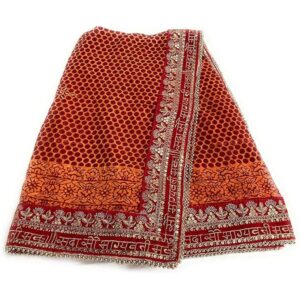
At its simplest, the Rangwali Pichoda is a large veil or stole (Odhni) that looks like a dupatta. However, unlike a regular dupatta, its dimensions are usually larger (often 2.5 to 3 meters), allowing it to drape gracefully over a saree or a lehenga.
The name comes from two Hindi words:
- Rangwali: Meaning “colorful” or “dyed.”
- Pichoda: Derived from “Pichhaura,” meaning something worn on the back or draped around.
While the attire of Uttarakhand varies from region to region, the Rangwali Pichora is distinctly Kumaoni. It is the visual marker of the region’s rich traditions, worn prominently in districts like Almora, Nainital, Pithoragarh, Bageshwar, and Champawat.
The Spiritual Meaning Behind the Yellow and Red Colors
You will never see a Pichoda in blue, green, or pink. It is strictly yellow (saffron) and red (maroon/crimson). But have you ever wondered why?
In our culture, colors speak a language of their own:
- The Yellow Base (Saffron): The background color represents the Sun and Brihaspati (Jupiter). Yellow is considered the holiest color in Hindu Dharma, symbolizing knowledge, spirituality, and purity. It reflects the glow of the Himalayan sun.
- The Red Motifs (Crimson): The red polka dots and designs symbolize energy, power (Shakti), and most importantly, Suhaag (marital bliss).
When these two colors come together in the Rangwali Pichhaura, they represent a prayer for a long, happy, and prosperous married life.
Decoding the Sacred Swastik and Sun Motifs on the Fabric
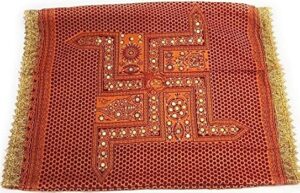
The beauty of a Rangili Pichodi Pahari lies in its design. It isn’t just random patterns; every symbol printed on the fabric has a deep spiritual meaning.
The layout usually centers around a main motif, surrounded by intricate borders.
-
The Swastik
Right in the center of the Pichoda, you will find a Swastik. It represents the four directions and the flow of Karma. It is an ancient symbol of auspiciousness, ensuring that good fortune comes from all sides.
-
The Sun and The Moon
Drawn alongside the Swastik are the Sun (Surya) and the Moon (Chandra). They symbolize eternity. The blessing implies: “May your married life and lineage last as long as the sun and moon shine in the sky.”
-
The Shankh (Conch) and Bell
-
- The Bell (Ghanti): Represents the divine sound that drives away negativity.
- The Shankh: Represents the purity of intent and the beginning of auspicious rituals.
-
The Dots (Bindu)
The entire yellow field is covered in red dots. These represent the stars in the sky or coins of prosperity, filling the wearer’s life with abundance.
How Traditional Pichoda Was Made Using Coins and Natural Dyes
Today, you can walk into a market in Haldwani or Almora and buy a readymade Rangwali Pichora. But ask the elderly women in your family, and they will tell you the beautiful stories of how they used to make it at home.
Decades ago, there were no screen prints. The fabric used was fine cotton or muslin.
- The Dye: The yellow color was extracted from Kilmora roots (a local berry bush) or pure turmeric (Haldi).
- The Coin Technique: This is the most nostalgic part! To create the red dots, women would take a 25-paisa or 50-paisa coin, wrap it in a thin cloth, dip it in homemade red dye, and stamp it onto the fabric one by one.
This handmade effort filled every thread of the Pichoda with love and personal care, making it a true heirloom.
Auspicious Occasions When Kumauni Women Wear the Pichoda
The Rangwali Pichoda is not for daily wear. It is reserved for the most sacred and celebratory moments in a woman’s life.
- Weddings: A Kumaoni bride is incomplete without her Pichoda. It is usually gifted by the bride’s family or her in-laws during the rituals.
- Namkaran: When a mother holds her newborn for the naming ceremony, she drapes the Pichoda to invoke blessings for the child.
- Festivals: During major festivals like Harela, Teej, or Karwa Chauth, married women proudly wear their traditional attire.
- Kalash Yatra: If you see a group of women carrying Kalash (holy pots) in Uttarakhand, you will see a mesmerizing wave of yellow and red Pichoras.
Rangwali Pichoda in Modern Times
Culture is like a river, it keeps flowing and changing. While the essence remains the same, the Rangwali Pichora has evolved.
- Fabric Shift: While cotton was the traditional choice, modern women prefer fabrics that are easier to drape and maintain, such as Georgette, Crepe, Silk, and Chiffon.
- Fashion Statement: It is no longer just for traditional ceremonies. Young Pahadi girls are styling it with fusion wear, and even non-Pahadi brides are adopting it because of its regal look.
- Availability: Earlier found only in local hill markets, you can now find Rangwali Pichoda online, shipping to Pahadis living in the US, UK, and cities like Delhi and Mumbai.
Conclusion
The Rangwali Pichoda is more than just a piece of cloth; it is a warm hug from our culture. In a world that is modernizing fast, seeing a woman in a Pichoda reminds us of our roots, our villages, and the simple joys of the mountains.
Whether you are a Pahadi living in the city or someone who loves Indian textiles, owning a Pichora is like owning a piece of the Himalayas.
Do you have a memory of your Nani or Dadi wearing her Pichoda? Or are you planning to wear one for an upcoming wedding? Share your stories in the comments below!